Alcohol as self-treatment for bipolar disorder
Once Upon a Time in HollywoodAlcohol as self-treatment for bipolar disorder is a recurring explanation for Rick Dalton’s drinking and a connection he shares with Pete Duel. The narrative presents alcohol not simply as an indulgence or a mark of weak character, but as the men’s unrecognized way of managing severe mood swings—an improvised relief that brings its own damage and, in Rick’s case, becomes harder to dismiss after Duel’s death.
Rick Dalton’s mood swings and drinking
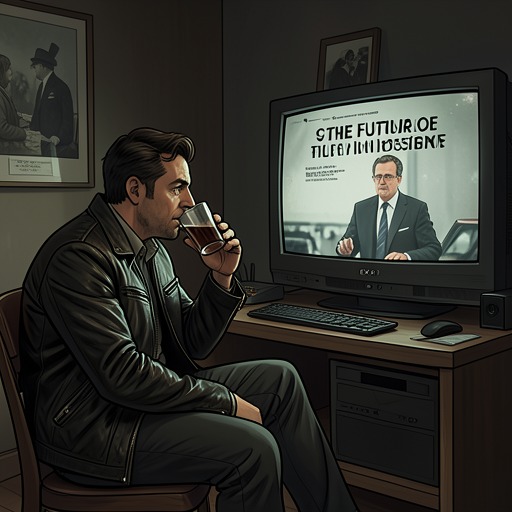
Rick’s mood swings date back to high school: his lows were unusually low, while his highs could approach mania. He does not know that he has bipolar disorder, a condition the narrative says was not commonly understood at the time. After he completes his four-picture deal with Universal Pictures, and particularly after Salty, the Talking Sea Otter, his downswings seem to reach a deeper low. The account locates the worst episodes in his lonely evenings, where boredom and self-pity feed self-loathing.
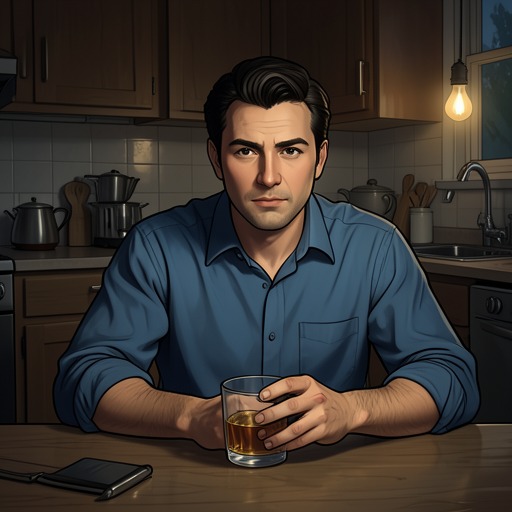
His drinking escalates from a couple of whiskey sours after work to eight, enough to black out. On one morning he wakes in bed, unaware of leaving the pool, removing his clothes, or getting into bed, and finds that he has vomited over himself. The clock radio reads 6:52, and Cliff Booth is due in about twenty minutes. Though the vomiting leaves him feeling physically better, he is still sick and ashamed. The episode makes visible the gap between alcohol’s short-term relief and its immediate consequences.
The narrative explicitly identifies Rick’s drinking as an attempted form of self-medication: whiskey sours are his only relief-inducing medication during the nighttime cycle of loneliness, boredom, and self-disgust. Elsewhere, it distinguishes this pattern from a general excuse for excessive drinking, describing Rick’s problem as arising from self-loathing, self-pity, and boredom. His career anxiety intensifies that context. After Marvin Schwarz’s blunt assessment of his prospects, Rick feels tears building; later, he describes his career to Cliff as a decline from ascent to a race to the bottom. Those moments establish distress around his profession, though the account does not reduce his mood disorder to career disappointment alone.
Pete Duel and a shared misreading
While filming Cannon for Cordoba in Mexico, Rick befriends Pete Duel, an actor who would later star in Alias Smith and Jones. They enjoy tequila, complain about Hollywood, pursue women, and each other’s company. Beneath that camaraderie, the narrative identifies a likeness neither man consciously understands: both have undiagnosed bipolar disorder, and alcohol is the only form of self-medication either knows.
Because neither recognizes the condition, they interpret their drinking as evidence of internal weakness. That misreading is central to the concept: the behavior is visible to them, but its relation to their mood swings is not. The account does not present a diagnosis sought or treatment received during their friendship; it emphasizes instead the absence of an explanation that might have changed how they understood their reliance on alcohol.
Duel’s death and Rick’s change
Duel’s drinking is described as more severe than Rick’s. At the height of his success on Alias Smith and Jones, he shoots himself in the middle of the night. The town wonders why he did it; Rick feels, privately, that he understands the answer. The narrative connects that sense of recognition to what both men shared, without claiming that alcohol or bipolar disorder alone explains Duel’s suicide.
After Duel’s death in 1971, Rick does the hard work of not leaning so heavily on booze. By 1973, while filming the revenge western The Deadly Trackers with Richard Harris in Durango, Mexico, the two heavy drinkers have reached a practical equilibrium: they stay off alcohol from Monday through Thursday, then drink heavily from Friday night into Sunday afternoon. This is a change in pattern, not abstinence. The account records both Rick’s effort to moderate his reliance and the continuing place of alcohol in his life.
Narrative significance
The concept changes the meaning of Rick’s blackouts and shame. What he experiences as weakness is, in the narrative’s retrospective account, bound up with an undiagnosed condition and an improvised means of coping. Duel’s similar experience makes that connection harder to treat as an isolated personal failing, while his death gives Rick a reason to reconsider his own dependence.
The story also keeps the consequences in view: alcohol offers Rick temporary relief, but leaves him blacked out, physically ill, and humiliated; later, moderation is achieved through limits on when he drinks rather than a clean break. By the time Rick can recognize the good fortune in his acting life, the narrative has already shown how profoundly self-loathing and professional insecurity could color his nights. That later gratitude supplies a contrast in perspective, but the text does not say it cured his disorder or ended his drinking.